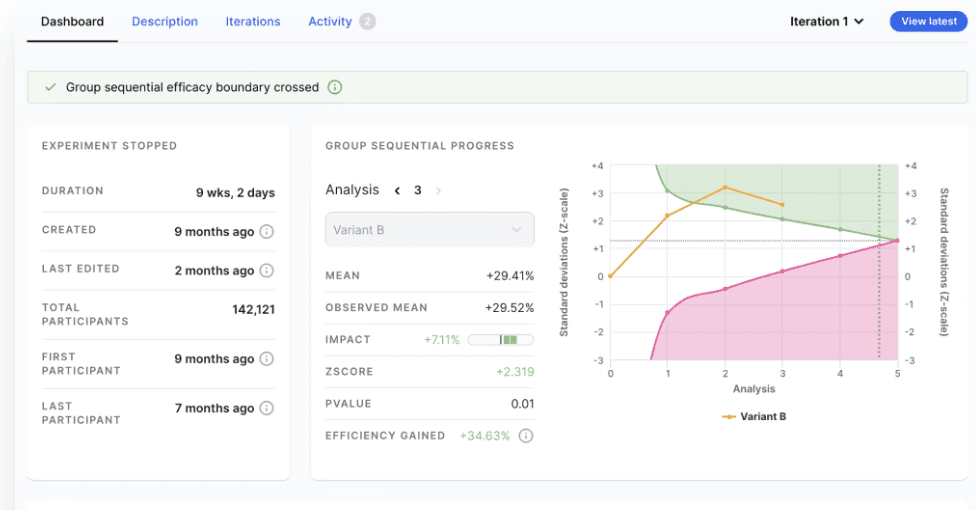
What if your teams could stop low-impact work sooner, act on strong signals faster, and make decisions with statistical confidence WITHOUT adding risk?
Group Sequential Testing (GST) makes that possible. It gives you planned checkpoints during an experiment where results can be evaluated. When there’s enough evidence, be it good or bad, you can stop early and move forward, rather than waiting for a test to run its full course. It reduces time-to-decision, improves resource efficiency, and accelerates product delivery. And because GST is statistically sound, you get the speed without the trade-offs.
When you’re scaling experimentation across multiple teams, GST supports faster feedback loops and smarter prioritisation, all while keeping data private and under your control.
What is Group Sequential Testing (GST)?
Group Sequential Testing (GST) is a statistical method that allows you to check on experiment results at several points throughout the test, not just at the end. These planned checkpoints let you decide whether to stop early when results are clear, or continue collecting data if they are not.
It helps reduce time spent on underperforming variants, speeds up iteration, and supports better use of resources across your testing program. Unlike traditional fixed-horizon tests, which only allow one analysis at the end, GST uses a method called alpha-spending to keep the overall false positive rate under control. That means you can look at your data more than once without introducing bias or inflating your error rate.
GST also works well in real-world testing environments. Whether your outcomes are delayed, your data arrives unevenly, or your test has operational constraints, GST helps you maintain high power to detect real effects and make confident decisions sooner.
How Does Group Sequential Testing Work?
Group Sequential Testing breaks an experiment into stages. At each stage, you evaluate the accumulated data to decide whether to continue or stop the test. These evaluations happen at predefined checkpoints. At each one, the platform calculates test statistics and compares them against thresholds. If a variation shows a clear, statistically significant effect, the test can end early. If it is unlikely to reach significance, you can stop the test and move on to the next idea.
This approach keeps your error rate under control by adjusting significance thresholds at each checkpoint. That means you can make multiple evaluations without increasing your false positive rate. GST is not new. It was originally developed for clinical trials, where early stopping can reduce patient exposure while still meeting false-positive standards. We’ve adapted it to product experimentation, where it helps teams move faster while staying statistically sound.
Benefits of Group Sequential Testing with ABsmartly
Group Sequential Testing helps teams move faster without compromising trust in their results. With GST, you can reduce test duration by up to 80 per cent compared to traditional fixed-horizon methods. That means quicker validation, faster iteration, and less time spent waiting for data.
Our platform is built to support scale. GST allows multiple teams to run experiments in parallel, with consistent statistical guarantees in place. This increases testing velocity across the organisation, helping you discover what works more quickly and apply those learnings with confidence. Because GST is fully integrated with our platform, you will see progress as it happens, without needing to export data or wait for post-hoc analysis.
For enterprise teams with complex infrastructure, ABsmartly provides full flexibility. Experiments can run across web, mobile, microservices, and even machine learning models, all while keeping your data in your own cloud environment. You stay in control, from setup to analysis.
Setting Up Group Sequential Tests on ABsmartly
Getting started with Group Sequential Testing on our platform is simple. You begin by defining either a minimum detectable effect (MDE) or a maximum runtime. This sets the stage for when and how interim checkpoints are evaluated. GST is the default analysis type for new experiments. You can configure variants, targeting, and tracking through our web console, or use our APIs to integrate across your stack.
Once the experiment is live, the platform automatically performs statistical checks at each checkpoint. If a result crosses the significance boundary, the test stops early. If not, it continues until the next checkpoint or until it reaches its endpoint. Throughout, error rates are carefully controlled using validated methods. Everything runs in your own cloud environment, so your data stays private and under your control. You get the benefits of a statistically rigorous system, without needing to build one yourself. Our Head of Product, Christophe Perrin, walks through the full setup of configuring GST experiments in this step-by-step video.
Common Questions About Group Sequential Testing Answered
Does Group Sequential Testing compromise accuracy for speed?
Not at all. Our implementation of Group Sequential Testing uses alpha-spending techniques to control the false-positive rate across multiple checkpoints. These methods come from clinical trials, where accuracy is non-negotiable.
That means even when you evaluate data more than once, your overall error rate stays within the same strict limits as traditional fixed-horizon tests. In fact, you keep the same statistical power, while often reaching conclusions much faster. It significantly speeds up decision-making, leading to 20% to 80% faster decisions on average.
Is it complicated to set up Group Sequential Testing?
It’s actually the default option on our platform. When you start a new experiment, you just choose either a minimum detectable effect or a maximum runtime. The platform then sets up the necessary checkpoints automatically.
Behind the scenes, we handle futility boundaries and spacing between analyses to keep things statistically valid. You can manage everything from the web console or integrate using our APIs and SDKs.
Whether you're running tests on web, mobile, backend services, or machine learning models, setup stays simple. No custom infrastructure needed.
Can I run multi-variant tests with GST?
Yes. Our platform supports Group Sequential Testing for experiments with up to four variants, plus a control group. This makes it ideal for multi-armed tests across different audiences or channels.
We apply advanced statistical corrections, like Dunnett’s method, to account for multiple comparisons without being overly conservative. It gives you more power to detect real effects, while keeping results trustworthy.
All processing happens in your own cloud environment, so you maintain full control over compliance and data privacy.
Why GST Makes Sense for Scaled Experimentation
Group Sequential Testing helps you move faster without lowering the bar for statistical quality. You can stop tests early when results are clear, reduce time-to-insight, and keep your teams focused on what works.
With support for multi-variant tests, real-time monitoring, and private cloud deployment, our platform is built for scale. You stay in control of your data, your process, and your experimentation culture.
If you’re curious about how this could work for your team, get in touch to book a demo, and we’ll walk you through it.