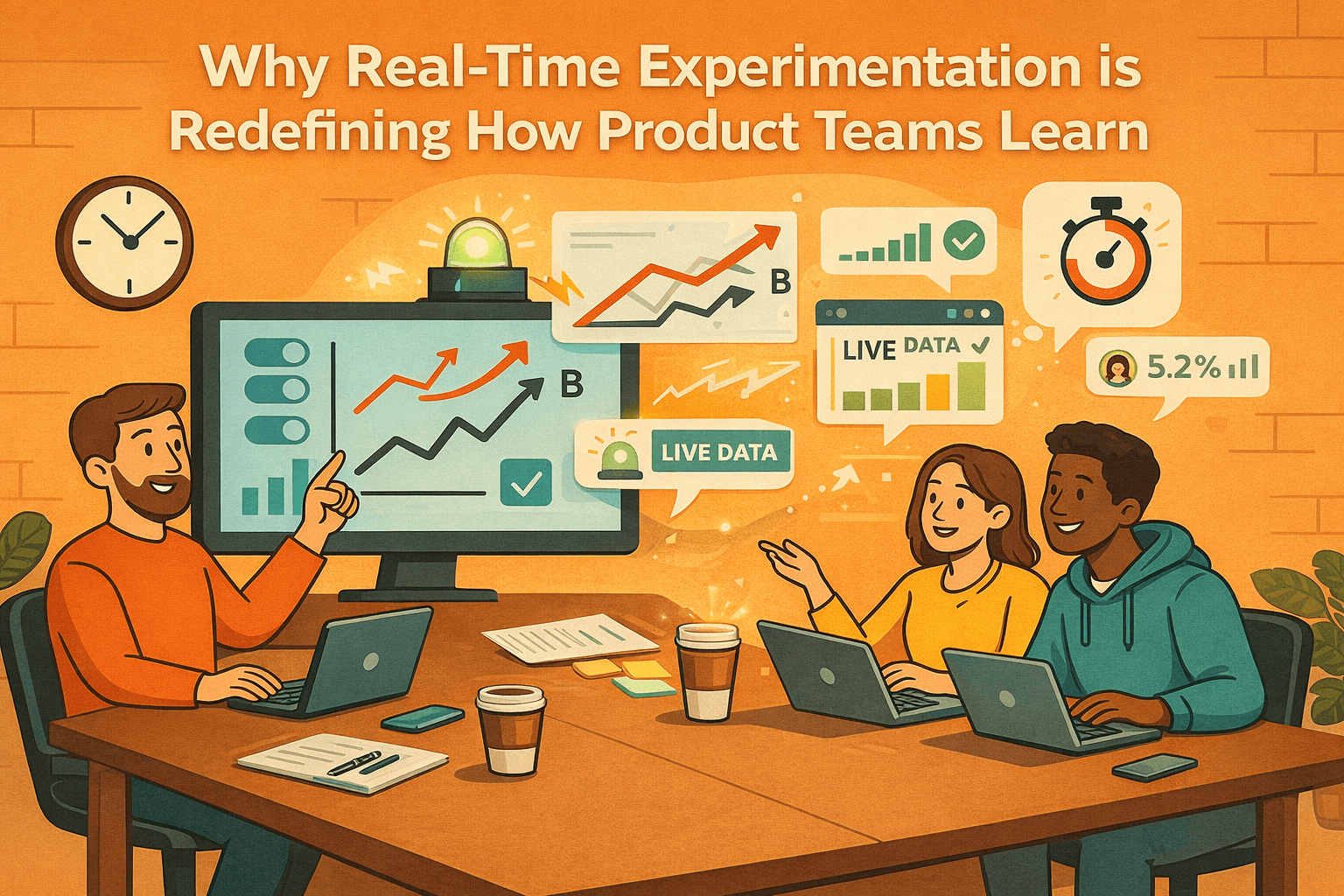
Experimentation is no longer optional for modern product organizations. In the past decade, A/B testing has evolved from a niche capability used by pioneers like Amazon, Booking.com, and Netflix into a standard expectation for product-driven companies everywhere. Today, experimentation is the engine that powers customer-centric innovation at scale.
But the field is changing. What worked a decade ago: batch-processed data, nightly updates, and delayed results, no longer fits the needs of teams shipping products continuously. As product development accelerates, expectations for experimentation platforms have shifted. Product managers, engineers, and data scientists don’t just want accurate insights, they need them immediately.
This is why real-time experimentation has become a defining frontier. And it’s not just a technical upgrade. At ABsmartly, and in the views of industry leaders like Jonas Alves and Lukas Vermeer, real-time is about reshaping how organizations make decisions, protect customers, and build trust in experimentation itself.
The Limits of Delayed Data
Many organizations still run their experiments on pipelines that refresh every few hours or overnight. For analysts, this seems like a tolerable inconvenience. For product teams, however, it creates costly friction:
Slower iteration: A product manager might wait a full sprint to act on results that could have been obvious within hours.
Customer exposure to harm: A broken checkout, spiking error rate, or degraded performance can persist unnoticed for days. By then, tens of thousands of users may have been impacted.
Eroded confidence: When results feel “too slow to matter,” teams bypass the experimentation platform entirely, undermining the culture of data-driven decisions.
Latency doesn’t just slow teams down but corrodes trust in experimentation. Without trust, organizations slip back into making decisions based on intuition, politics, or the loudest voice in the room.
What Real-Time Experimentation Unlocks
Streaming experimentation pipelines—where metrics update as soon as data arrives—transform how teams build and ship products. The value extends far beyond speed:
1. Early Detection of Problems
Picture a payments team experimenting with a redesigned checkout form. Within minutes of rollout, conversion begins to dip by 1%. With delayed pipelines, this wouldn’t be visible until the next day, by which point thousands of customers may have abandoned their purchase. With real-time monitoring, the anomaly appears immediately, and the team can pause or roll back before revenue loss escalates.
The same applies to technical performance. Streaming services like Netflix use real-time metrics to detect video playback issues during experiments. Without this visibility, customer frustration would grow long before data scientists had results to analyze.
2. Faster Iteration Loops
Product teams thrive on rapid feedback. Real-time insights mean that by the afternoon of launch day, teams already see directional signals: is the new feature stable? Are error rates holding steady? Does engagement trend up or down?
This doesn’t mean declaring winners early, but it does mean teams can confidently decide whether to continue, adjust, or abandon an experiment without losing valuable time. Faster loops mean more experiments per quarter, more learning, and ultimately, more innovation.
3. Operational Confidence
Real-time data also functions as an operational monitoring system. Engineers can see instantly if logging breaks, pipelines fail, or anomalous traffic patterns emerge. This transparency builds trust across teams. Product managers know that harmful effects won’t go unnoticed, and engineers know they’ll be alerted before small glitches become systemic failures.
4. Cultural Momentum
Experimentation culture can be fragile. If results take days to appear, teams may disengage, their curiosity fading. Experiments get checked “later,” if at all. Real-time results restore momentum by keeping experimentation in sync with the daily rhythm of product development.
When teams can watch metrics update live, the process feels tangible and rewarding. Curiosity flourishes, evidence becomes part of everyday discussions, and decisions increasingly lean on data rather than opinion.
The Counterpoint: Real-Time Alone Isn’t Enough
Critics of real-time experimentation warn of a genuine risk: “peeking.” When data updates continuously, teams may be tempted to call winners prematurely. Acting on incomplete signals inflates false positives and undermines the credibility of results.
This concern is valid. But it doesn’t mean organizations should reject real-time capabilities. Instead, it highlights the importance of pairing speed with rigor.
As Jonas Alves emphasizes:
Real-time data should be used for monitoring health and detecting harm early.
Statistical validity must still guide final decisions.
Discipline matters: teams must separate operational signals from evaluative conclusions.
In practice, this means a checkout team might use real-time data to roll back an experiment showing early signs of harm, but wait until full statistical significance before concluding whether the new design improves conversions.
Real-time experimentation is not about shortcuts. It’s about empowering teams to act responsibly faster.
How Leading Companies Use Real-Time Experimentation
Industry leaders provide concrete examples of how real-time capabilities drive value:
Netflix: Streams performance metrics during experiments to ensure playback quality remains stable. A sudden rise in buffering can trigger a rollback long before customers churn.
Booking.com: Pioneered real-time anomaly detection to protect customer experience. Experiments that cause site outages or payment issues are halted instantly, not discovered after hours of damage.
Amazon: Uses real-time monitoring not just for customer-facing metrics, but also for backend systems. Engineers can identify unintended side effects, such as database load spikes, before they impact millions of users.
These organizations demonstrate that real-time experimentation is not about chasing statistical significance faster, but about building resilience, responsiveness, and trust in their experimentation cultures.
Making Real-Time Responsible: Practical Guidance for Product Teams
For product professionals adopting or scaling real-time experimentation, three principles can guide responsible use:
Use Real-Time for Safeguards, Not Shortcuts
Treat real-time visibility as an early-warning system. Monitor error rates, crashes, and funnel drop-offs continuously. Stop harmful experiments quickly, but resist the urge to call winners prematurely.Operationalize Monitoring
Establish dashboards that distinguish between business metrics (conversions, engagement) and operational metrics (errors, latency, traffic anomalies). Make real-time monitoring part of your deployment checklist.Anchor on Statistical Rigor
Build organizational norms that reinforce patience in decision-making. Train teams to interpret real-time data as a signal of direction and health, not final judgment. Only act on outcomes once your statistical thresholds are met.
By codifying these practices, product organizations can enjoy the speed and safety of real-time experimentation without compromising on rigor.
The Strategic Value of Real-Time Experimentation
Real-time experimentation is not just a technical feature. It is a strategic enabler for product organizations competing in fast-moving markets.
It protects customers by reducing exposure to harmful experiences.
It accelerates learning by shrinking iteration cycles.
It builds organizational trust by aligning experimentation with the pace of product development.
The companies that lead in experimentation culture, such as Amazon, Booking.com, Netflix, have already embraced these principles. For everyone else, real-time experimentation is quickly shifting from an advantage to an expectation.
Looking Ahead
At ABsmartly, we believe the future of experimentation platforms is not just about reporting results. It’s about becoming active partners in decision-making. Real-time pipelines, anomaly detection, and built-in statistical safeguards are key components of that future.
For product teams, the question is no longer whether real-time experimentation is valuable, but how long you can afford to operate without it. Delayed insights mean delayed learning, slower decisions, and unnecessary customer exposure to risk.
In today’s environment, that is not just inefficient, it’s unacceptable.